
Atchison Projected and Actual Release
A projected date estimates when release may occur under the sentence calculation and present assumptions. An actual release date records the custody event that happened. The MODOC glossary distinguishes minimum, conditional, presumptive parole, projected time-credit, maximum, and final-discharge concepts. They describe different legal or administrative points and must not be swapped.
A presumptive parole release date is tentative and depends on appropriate institutional conduct and an acceptable release plan. A projected time-credit release date is an administrative-parole consideration point for an eligible person. A minimum date can identify a conditional-release or eligibility point. A maximum date represents the sentence expiration endpoint in the public data. None alone proves the date and time a person walked out.
- Projected date
- A calculated date that can change when sentence facts, credits, conduct, holds, or decisions change.
- Conditional release
- A supervised part of certain prison sentences, not final discharge.
- Detainer
- A hold or request from another authority that can prevent community release.
- Discharge
- The formal end of the sentence or supervision obligation, often later than prison release.
Find an Atchison Projected Release Date
Classify the custody before searching. A county arrest begins with the Atchison County Jail and the criminal court. A Missouri prison sentence belongs to MODOC. The local jail cannot calculate a state prison release, and MODOC cannot establish the exact exit time from a county booking.
- Identify whether the person is pretrial, serving a county sentence, committed to MODOC, or held by another authority.
- For a county case, read Case.net for the judgment, sentence, bond, jail-credit entries, and later court orders.
- Ask the Atchison County Jail for the actual release event and how county-sentence days were credited.
- For state custody, search the MODOC active Offender Search and match the DOC identifier, name, birth data, offense county, and assigned place.
- Use the historical Sunshine data for completed or past supervision, then request the sentence calculation and release order when certainty is needed.
- After the expected date, confirm the institutional or jail release rather than assuming it occurred.
The active MODOC search includes active offenders, probationers, and parolees. It excludes discharged offenders. A field assignment may show prison release to supervision, while an institutional assignment shows state custody. A no-result cannot establish county release or final discharge.
For the complete county, court, and state search sequence, consult the Atchison County released inmate lookup. It keeps a local booking separate from a later state transfer.
Note: A pretrial detainee has no fixed sentence-release date because bond, court orders, and other holds control the next event.
Atchison MODOC Release-Date Fields
The official MODOC Sunshine database covers people who are or have been under department supervision. It may show more than one row for a person because sentences and charges are represented separately. The data can also be incomplete, inaccurate, or based partly on self-reported information. Reconcile every row before drawing a conclusion.
| Official field | Meaning and limit |
|---|---|
| DOC identifier | The stable state-system key used to match the person across records |
| Assigned place | An institution or field location that helps distinguish prison custody from community supervision |
| Field/institution indicator | Shows whether the assignment is in an institution or the community field system |
| Sentence-I Minimum Release Date | A calculated minimum release date on an active sentence, not an actual exit timestamp |
| Sentence Maximum Release Date | The maximum release or expiration date represented for that sentence |
| Completed Flag | Y means that sentence row is complete; another row may still be active |
The public search landing page does not prove that every result contains a field literally called “projected release date.” Use the label that appears in the live record. The historical file’s field dictionary supplies minimum and maximum fields, while Missouri’s administrative rule defines projected time-credit release date.
The MODOC Sunshine Law data page shown below is the official route to nightly historical data and its field definitions.
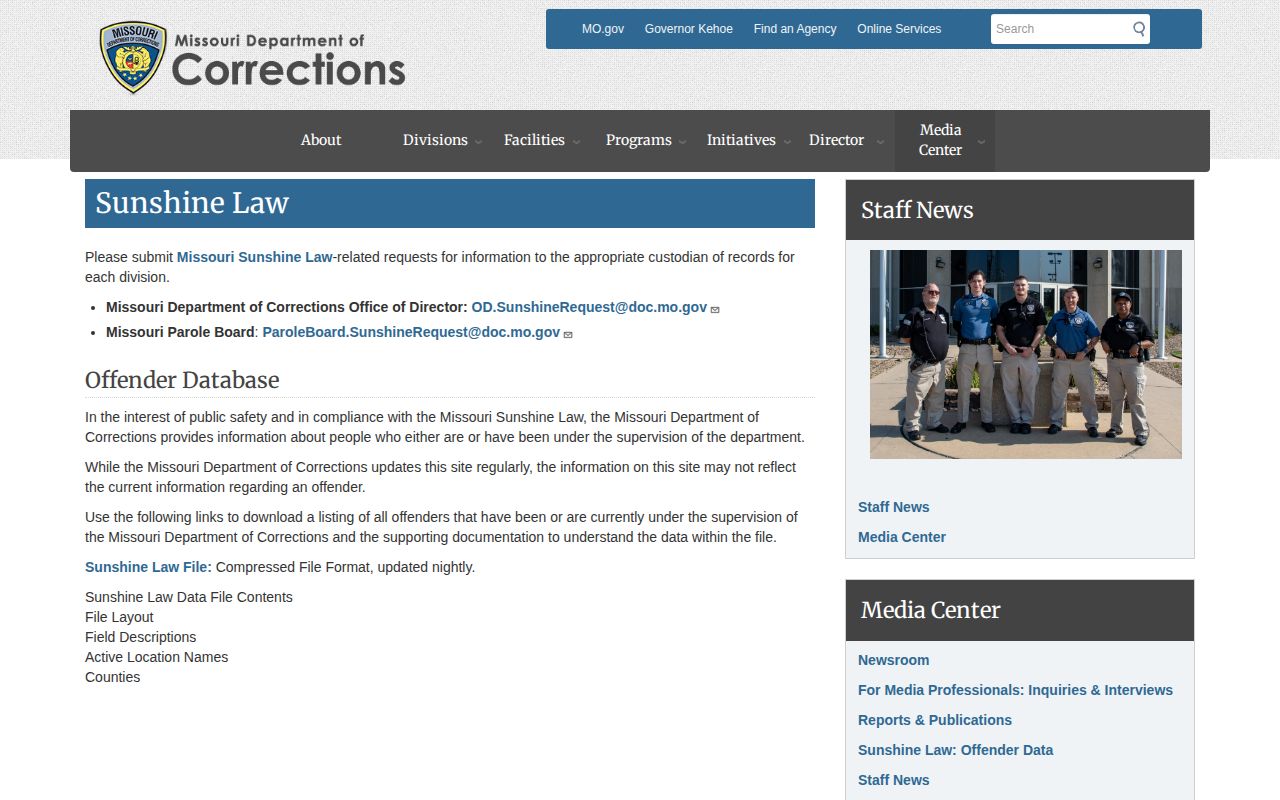
The nightly file is a preliminary research source, not a certified individualized release or discharge record.
Missouri Conditional Release Calculations
Missouri sentence calculations begin with the judgment. Read sentence length, concurrent or consecutive structure, offense, felony class, jail credit, and statutory restrictions. Then apply the ordinary conditional-release portion, minimum-prison-term rules, Board decision, authorized credits, conduct, programs, and outside holds. Skipping one layer can produce a false date.
Section 558.011 generally divides eligible terms of years into prison and conditional-release portions. For covered terms of nine years or less, the conditional-release term is generally one-third. For more than nine through fifteen years, it is three years. For terms over fifteen years, it is five years, with the prison portion being the balance. Dangerous felonies and certain fourth or later remands are excluded from that general division.
The Board can extend the conditional-release date toward the full sentence after the required process. MODOC’s conditional-release timing explanation provides agency context. That is one reason a sentence fraction cannot be treated as a promised door date. The statute’s applicable version and the exact offense also matter.
The official Missouri conditional-release statute appears below with the text that governs eligible terms.
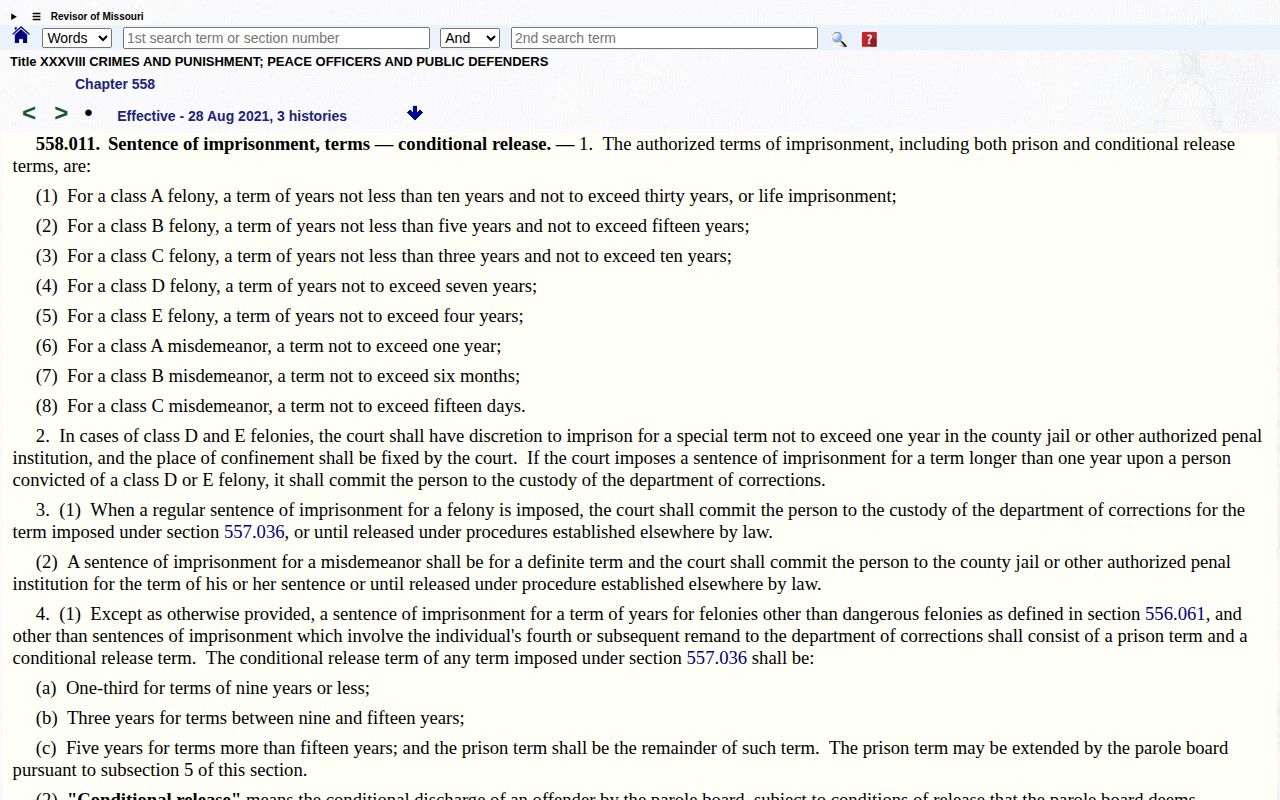
The statutory portion is only one part of the full MODOC calculation and must be read with minimum terms, credits, holds, and Board action.
Atchison Minimum Terms and Credits
Section 558.019 establishes Missouri minimum prison terms. Its current text includes repeat-commitment percentages and requires a person convicted of a dangerous felony and committed to MODOC to serve 85 percent of the sentence, or until age seventy after serving at least forty percent, whichever occurs first, under the statute’s terms. The MODOC offender profile supplies agency context for this rule. “Minimum prison term” is the period before eligibility for parole, conditional release, or another early release. It is not a rule that everyone serves the same fraction.
Regulation 14 CSR 10-5.010 defines a projected time credit release date by subtracting authorized credit from the conditional-release date. It describes one calendar month per year for eligible Class A or B sentences and two months per year for eligible Class C or D sentences, subject to exclusions. Acceptable behavior and program involvement may support consideration for administrative parole. Consideration is not guaranteed release.
Section 558.041 authorizes qualifying credit on the superintendent’s recommendation and permits rescission for violations. Section 558.031 governs jail-time credit connected with the offense. A correct estimate must keep jail credit, administrative credit, and parole eligibility separate.
Note: Time credit may move a consideration point, but it does not erase a detainer or guarantee that release processing will occur.
Why Atchison Release Dates Change
A projected release date is built from facts that can change. Some changes come from the court, others from MODOC, the Board, or another agency. The record should identify the source rather than attributing every shift to “good time.”
| Factor | Possible effect | Record to check |
|---|---|---|
| Sentence amendment or credit ruling | Changes the base term or credited custody | Judgment and court docket |
| Concurrent or consecutive sentences | Changes how multiple terms combine | Judgments and sentence calculation |
| Time-credit award or rescission | Moves the projected consideration point | MODOC calculation and credit record |
| Conduct or program status | Affects eligibility or a tentative date | Institution and Board records |
| Parole Board action | Sets, denies, delays, or revisits a future date | Exact Board decision |
| Detainer or outside hold | Can redirect the person to another custodian | Release destination and receiving agency |
| Other active sentence rows | One completed row may not end all custody | All DOC cause and sentence rows |
A release plan can also matter for a presumptive parole date. Even when an institution releases someone, a transfer to another jail, MODOC unit, ICE, or the U.S. Marshals Service is continuing custody rather than community release.
Atchison County Jail Release Dates
County jail calculations are different from MODOC prison calculations. No published Atchison County good-time policy, weekend-release rule, or local sentence-credit formula was found. Do not apply the state administrative time-credit regulation to a county jail term.
For a county sentence, read the court judgment, sentence length, jail-credit entry, and later orders. Ask the Sheriff’s Office how days were credited and request the actual release event after the expected date. For a pretrial case, look instead at bond, recognizance, dismissal, warrants, and holds. A court order can precede physical release while jail staff complete processing and check for other authority.
The local release record should separate release to the community from transfer. Ask for date and time, release type or authority, and destination or receiving agency if recorded and open. This is the only sound way to state what ended the Atchison County booking.
Confirm an Atchison Actual Release
After a projected date arrives, verify the custody event. For a state prisoner, check whether MODOC now shows field supervision, then request the institutional release date and type if a formal record is needed. For a county inmate, call the jail and request the release event. A VINELink status alert can provide a prompt, but the Atchison County VINELink check remains a notification tool rather than the final record.
For MODOC records, a focused request may ask for the sentence-calculation sheet, institutional release event, parole or conditional-release order, current supervision status, and final discharge certificate as separate items. Formal Sunshine requests can go to OD.SunshineRequest@doc.mo.gov, with Parole Board records directed to ParoleBoard.SunshineRequest@doc.mo.gov.
When a Board hearing is part of the calculation, use the precise decision text. Missouri’s hearing process may result in a future release date, another hearing, or other Board action. The Board generally estimates eight to twelve weeks for a decision after a hearing, but that time concerns the decision process, not the person’s release. A future date can remain subject to conduct, programs, the release plan, sentence restrictions, and other holds.
If a public answer is unclear, include the DOC identifier, full name, date of birth, and cause number in a focused inquiry. Ask whether the displayed date is a minimum, maximum, presumptive parole, conditional-release, projected time-credit, actual institutional release, or final discharge date. This wording prompts the agency to identify the field instead of returning a vague “release date” that could be misread.
Those records answer different questions. The calculation explains the estimate. The release event states when institutional custody ended. The supervision record shows whether the sentence remained active in the community. The discharge certificate confirms when the state obligation ended.
Public Record Search
Sponsored Results