
Atchison Parole and Probation Compared
The MODOC Division of Probation and Parole uses several community statuses, and the label matters. Probation is imposed by a court instead of incarceration or after a suspended sentence. Parole is a discretionary release granted by the Missouri Parole Board under the state parole framework before the full sentence expires. Conditional release is the supervised portion built into certain prison sentences. A person in any of these categories may live in the community while still appearing as an active Missouri Department of Corrections offender.
A county booking can close without creating parole. Someone may leave the Atchison County Jail on bond, recognizance, time served, dismissal, or transfer. Parole applies only after a state prison term and Board action. Probation comes from the court record. The Atchison County released inmate search and record path helps distinguish the jail event from the later supervision record.
| Status | Who orders it | What it means | Best confirmation |
|---|---|---|---|
| Probation | Sentencing court | A community sentence with conditions | Case.net, active MODOC search, assigned office |
| Parole | Missouri Parole Board | Discretionary prison release before sentence end | MODOC status, Board record, assigned office |
| Conditional release | Missouri law and MODOC process | A supervised part of an eligible prison sentence | MODOC release and supervision records |
| Final discharge | Board or sentence completion process | The supervision obligation has ended | Final order or certificate of discharge |
- Supervision
- Community oversight while a sentence, probation term, parole term, or conditional-release term remains active.
- Absconder
- An agency-determined status tied to failure to remain in contact or comply, not a guess based on a missing web result.
- Discharge
- The formal end of the sentence or supervision obligation, which occurs after release in many cases.
Verify Atchison Post-Release Supervision
The MODOC active Offender Search is the first public check for a person thought to be on parole, probation, or conditional release. Its welcome page says the tool covers active offenders, including probationers and parolees. It excludes discharged offenders. A no-result therefore cannot prove that the person was never supervised or that a county jail release occurred.
Match records conservatively. Names and aliases can overlap. A field or probation-and-parole assignment supports current community supervision, while an institution assignment means the person remains in state custody. Use the search result as a lead and confirm the status with the responsible office.
- Search the full first and last name, consider known aliases, and complete the required CAPTCHA normally.
- Compare the DOC number, middle name, birth data, offense county, and case details that are available.
- Read the assigned place and status. Separate an institution from a field supervision assignment.
- Contact District 1 and ask whether it holds the assignment or whether another office is responsible.
- For a fully ended term, request the release order and final discharge record rather than relying on the active search.
MODOC’s public-information categories include confirmation of supervision, supervising officer and office, supervision term, standard and special conditions, custody or bond status, parole or conditional-release date, and a Board release decision. The agency’s Public Information and Constituent Services office provides an escalation route. Ask only for the fact needed. Safety and privacy limits can restrict some details.
Note: A field assignment can confirm community supervision, but it does not prove final discharge or establish the person’s home address.
Atchison Supervision Starts at District 1
Atchison County is not served by a county-only parole office. The official District 1 profile places Atchison with Nodaway, Worth, Holt, Gentry, Andrew, and Buchanan Counties in a seven-county region. The profile reports about 991 client cases per year, an average staff of 24 officers, and about 41 clients per officer. Those figures describe the full district. They are not Atchison County counts.
The regional design matters when checking supervision. A person may live in Atchison County but report through St. Joseph or another assigned location. Do not infer an office or a check-in routine from the person’s residence. The supervising officer sets case-specific instructions.
The official probation and parole address listing is the source for the current District 1 contact. MODOC’s family and friends guide supplies the general weekday office hours and after-hours command route:
District 1 / St. Joseph Community Supervision Center3305 Faraon St.
St. Joseph, MO 64506
816-271-3131
Weekdays, 8:00 a.m. to 5:00 p.m., except state holidays
The office listing shows where to begin, not where a supervised person lives. Ask whether the case is assigned there before sending records or arriving in person.
The official District 1 page shown below identifies Atchison County as part of the regional supervision district.
View the MODOC District 1 profile used for Atchison County supervision.
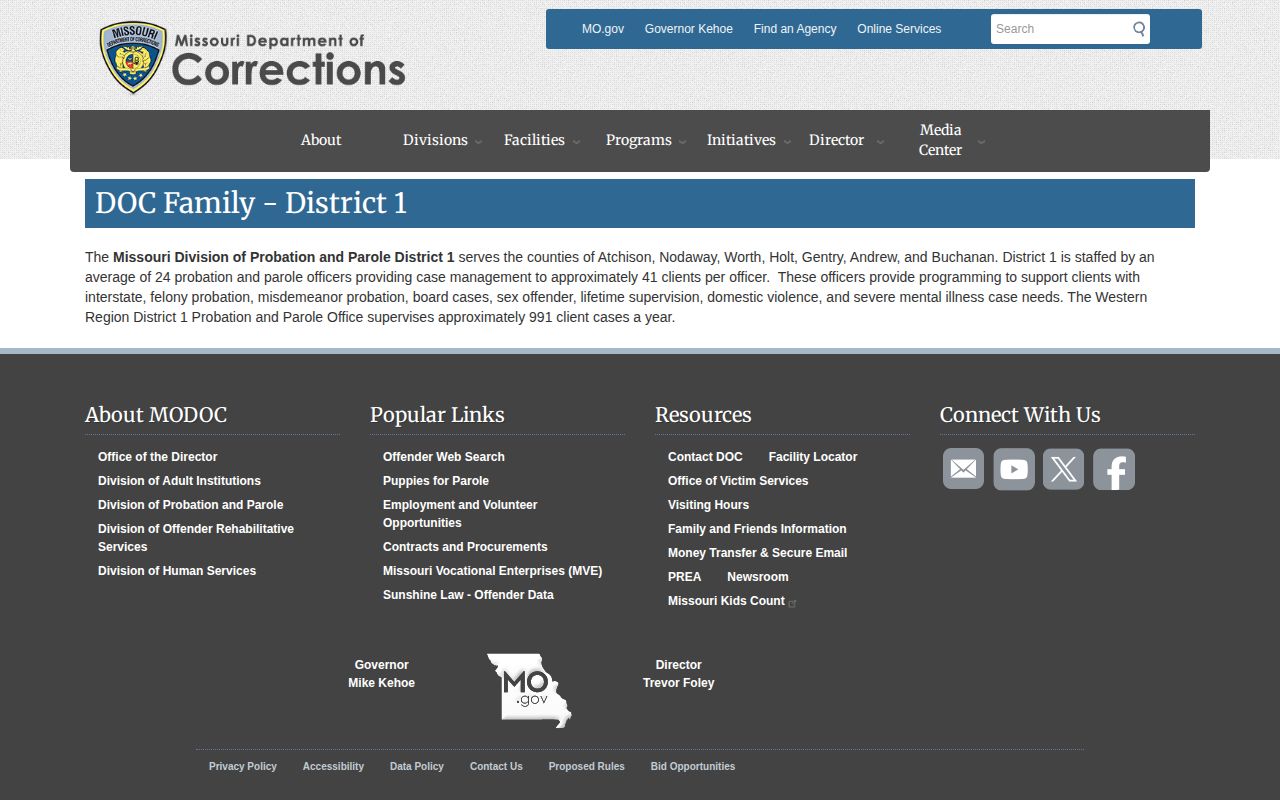
The regional listing is why a Rock Port reporting office or standard walk-in schedule should not be assumed.
Atchison Parole Hearings and Dates
A parole hearing is not an actual release. The Missouri Parole Board uses its Blue Book and sentence-length schedule to determine when hearings may occur. No open, name-based calendar with dated hearings for every person was found. The schedule table should not be described as a live calendar.
The Board reviews conduct, institutional adjustment, completed and needed programs, the sentence, and other relevant facts. Its hearing-process information says a decision generally takes about eight to twelve weeks. An outcome can set a future release date, schedule another hearing in one to five years, or take another form allowed by Board rules. Use the actual decision wording.
A future Board date may still be affected by statutory minimum terms, consecutive sentences, offense restrictions, conduct, and the release plan. The institutional release event must be checked after the decision. For date concepts and sentence factors, see the Atchison County projected release date explanation.
When no public result is available, a focused request may go to ParoleBoard.SunshineRequest@doc.mo.gov. Include the DOC identifier, sentence, offense, cause number, and the precise hearing or decision record sought. Board operations can be reached through DOC.COBoardOperations@doc.mo.gov or 573-751-8488.
Atchison Supervision Violations and Absconders
Conditions are the rules attached to probation, parole, or conditional release. They may include standard terms and case-specific terms. A violation allegation does not by itself state the final result. The supervising agency and court or Board process determine what happened, and the record may show continued supervision, changed conditions, a warrant, revocation, or another action.
An absconder is not simply someone who cannot be found online. MODOC uses the term for an agency status arising from a failure to remain in contact or comply. No Atchison County public absconder list was located. The MODOC Command Center works with law enforcement on absconder matters, but a reader should confirm the status through District 1, the court docket, and current warrant sources rather than apply the label by inference.
For after-hours emergencies connected with supervision, the P&P Command Center number published by MODOC is 888-869-3195. Routine record questions belong with the assigned office or the agency’s records channel, not the emergency line.
Note: Registry absconder information applies only to people under registration law and is not a general probation or parole list.
Clarify Atchison Supervision Records
Atchison County has no verified local online release archive. When a supervision or release detail appears wrong, begin with the office that created the record. For a jail event, that is usually the Atchison County Sheriff. For a parole, conditional-release, supervision, or final-discharge record, it is MODOC or the Parole Board.
A focused Missouri Sunshine request should identify the person and booking or DOC number, name the disputed date or status, and ask for the underlying release log, order, or supervision record. If the record is said not to exist, ask for the applicable retention schedule. Under section 610.023, the public body must act as soon as possible and no later than the end of the third business day. That is a response deadline, not always a production deadline. A later production date should come with a detailed explanation.
Request segregable open material if part of the file is closed. If a request is denied, ask for the statute that supports the denial. A correction request should describe the precise field in dispute rather than ask an office to rewrite a broad history.
How Atchison Supervision Ends
Release from prison and discharge from supervision are not the same event. Missouri law permits a person to leave an institution on parole or conditional release while the sentence remains active. The MODOC active search may still show that person under field supervision. Final discharge comes later through sentence completion or a formal order.
Under section 217.730, the Parole Board may issue a final order or certificate of discharge after obligations are met, generally not less than three years after parole or conditional release unless the sentence expires earlier. The specific sentence controls. A completed flag in the historical file also applies to a sentence row, and one completed row may coexist with another active row.
The historical MODOC file can help locate a past sentence, but it is not a certified answer about one person. Review the DOC identifier, cause number, offense county, assigned place, field or institution indicator, probation dates, minimum and maximum dates, and every completed flag. Multiple rows may represent separate charges or terms. A completed flag on one row cannot close the analysis if another row remains active.
For solid proof, follow the MODOC contact routing and request separate records for the institutional release date and type, the parole or conditional-release order, the active supervision status, and the final discharge certificate. Keeping those documents distinct prevents a prison exit from being reported as the end of all state supervision.
Public Record Search
Sponsored Results